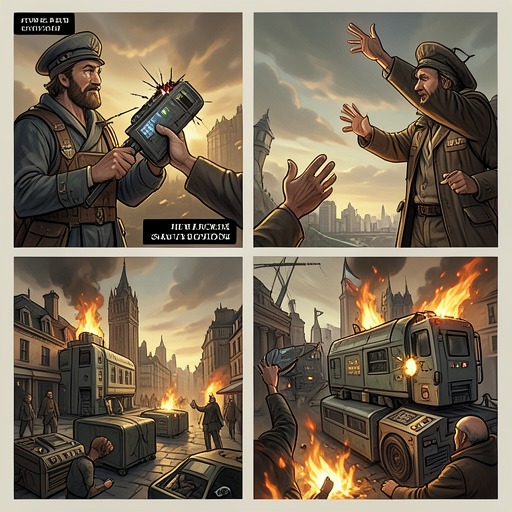
Destruction of Ammonihah
Book of MormonThe Destruction of Ammonihah is one of the most severe episodes in the record of the Nephites: in the eleventh year of the reign of the judges, a Lamanite army entered from the wilderness side, attacked the borders, and destroyed the city of Ammonihah. The Lamanites were later driven into the wilderness, but the city’s people were not restored; every living soul of the Ammonihahites was destroyed, and the once-inhabited place was left desolate in one day. The episode therefore joins warfare to judgment and makes the fate of a single city part of the book’s larger concern with covenant warning, historical memory, and the consequences of collective rebellion.
Causes and Background
The destruction occurs after a period in which Ammonihah stands as a hostile setting for prophetic ministry. The supplied record identifies the event within the eleventh year of the judges’ reign and introduces it through a cry of war heard throughout the land. The attack is not presented as an isolated skirmish: the Lamanite armies come in from the wilderness side, cross into the borders, and move directly against the city. Its geography matters because the wilderness functions as the route through which danger reaches a community that had apparently regarded itself as secure.
The event also belongs to a history in which peoples are repeatedly displaced, divided, and reunited. The record traces ancestry and migration back to Jerusalem, including the account that the people of Zarahemla came out from Jerusalem when Zedekiah was carried captive into Babylon. It also describes the broader division between the Nephites and the Lamanites, with the River Sidon running east to west between their lands. Against that background, Ammonihah’s fall is more than a local military incident: it is a destructive turn within a long history of migration, territorial division, and conflict between related peoples.
The book’s framing statements give the event a further horizon. Its records are described as an abridgment preserved for the remnant of the house of Israel and for Jew and Gentile, so that readers may know what the Lord has done for earlier generations and may recognize that the house of Israel is not cast off forever. The destruction of Ammonihah consequently survives not as an unexplained ruin but as remembered history, selected within a record whose stated purpose is to teach through the rise and collapse of communities.
The Attack and the Fall of the City
The immediate narrative begins with the sound of war throughout the land. The Lamanite armies enter from the wilderness side, reach the borders of Ammonihah, and begin killing the people and destroying the city. The wording emphasizes simultaneous human and architectural ruin: the inhabitants are slain while the civic space that contains them is broken apart. Ammonihah is not merely defeated and occupied; it is attacked as a population center and erased as a functioning settlement.
Nephite armies eventually come upon the Lamanite forces near the River Sidon. The Lamanites are scattered and driven into the wilderness, and Nephite forces recover their brethren who had been taken captive and return them to their own lands. This counteraction establishes an important contrast within the event. The invading army is defeated and expelled, but military recovery cannot reverse the destruction already inflicted on Ammonihah. Captives can be brought home; the city’s dead cannot be restored, and the community itself cannot be reconstituted.
The chronology gives the catastrophe a defined historical boundary. With the Lamanites driven out and the people of Ammonihah destroyed, the eleventh year of the judges ends. The city’s fall thus becomes the culminating fact by which that year is remembered. The record does not treat the episode as an indefinite period of decline but as a concentrated reversal: warning and political time give way to invasion, slaughter, expulsion, and final desolation.
Desolation and Aftermath
The most devastating detail is the totality of the loss. The account states that every living soul of the Ammonihahites was destroyed, while also noting that the Lamanites did not destroy the city because of its greatness. The apparent tension between the city’s size and its fate sharpens the event’s irony. Greatness offers no protection when an attacking force reaches the community, and the scale of the settlement only makes the suddenness of its disappearance more striking.
The city is described as left desolate in one day. Its carcasses are mangled by dogs and wild beasts of the wilderness, an image that removes any possibility of orderly burial, civic mourning, or immediate recovery. The wilderness that served as the avenue of attack becomes the agent of the city’s final abandonment, reclaiming the remains after human violence has ended. The aftermath is therefore not a negotiated transfer of power but a landscape of death in which Ammonihah’s social identity has disappeared.
The surviving Nephite response is limited but concrete: the Lamanite army is scattered, captives are recovered, and the captives are returned to their own lands. Those actions restore some persons to safety, yet they also underline the asymmetry of the aftermath. The larger political order can repel the enemy, but it cannot recover the destroyed population or undo the city’s transformation into a desolate place.
Narrative Significance
The event gives material form to the record’s recurring relationship between warning and historical consequence. The book presents itself as a record preserved by commandment, prophecy, and revelation, and it asks later readers to learn from what happened to earlier peoples. Within that design, Ammonihah’s destruction is a warning embodied in ruins rather than merely stated in doctrine. The city becomes evidence that communal security, size, and established place do not guarantee survival.
Its narrative structure also depends on contrast. The Lamanites arrive from the wilderness and destroy Ammonihah; the Nephite armies later drive the Lamanites back into that wilderness. The enemy’s retreat may look like a military resolution, but the city’s annihilation prevents a fully restorative ending. The story closes with expulsion of the attackers and persistence of the wound: the land can be defended after the fact, while the community that bore the first blow remains gone.
The event’s memorial function reaches beyond the local conflict. The record includes histories of the Nephites, the Lamanites, and the people of Jared, and it declares that these histories are meant to convince readers that Jesus Christ is the Eternal God manifested to all nations. In that theological architecture, Ammonihah’s fall is one fragment in a much larger cycle of warning, destruction, remembrance, and hoped-for gathering. Later proclamations promise that the Lord will establish his people and address the house of Israel, but those promises do not erase the particularity of Ammonihah’s loss. The city remains a grave example of how a people can vanish from its place, leaving its destruction to instruct those who come afterward.